Analysis and operations
Operational Analysis: VivaColombia Airlines
A service-operations case study on VivaColombia's low-cost airline model in Latin America — its funding strategy, workforce management, customer experience, and the board's 2015 expand-vs-consolidate decision.
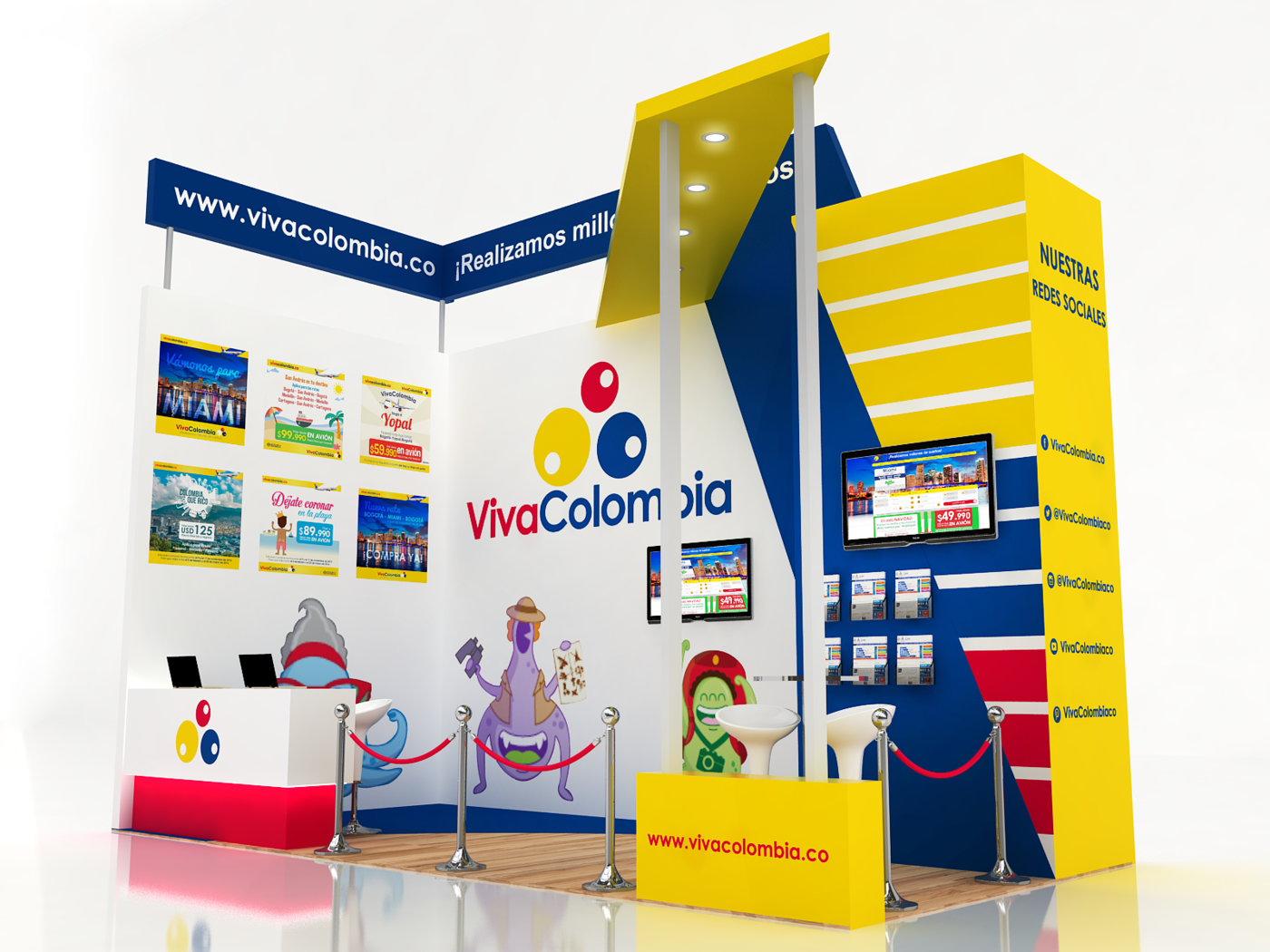
In 2007, the idea of bringing a low-cost-carrier (LCC) business model to Colombia was born. VivaColombia started as a Stanford University project of one of its founders, William Shaw (former British Airways CEO), who brought in Juan Emilio Posada (former Avianca CEO), Fred Jacobsen (former Tampa Cargo CEO), and Gabriel Migowski (former Brazilian Air executive) to turn the idea into a business. The four had the combined experience needed to build the company, and after much discussion agreed to pursue the opportunity in Colombia. Founded initially in 2008 as Fast Colombia, VivaColombia went through several regulatory hurdles before finally beginning operations in May 2012.1
VivaColombia: the challenge of growing a low-cost airline in Latin America
The case narrates the airline’s history from 2012 to 2015, at which point the board of directors had to decide: expand into a new market in Brazil, or consolidate local operations to improve standards, consistency of service, and customer satisfaction. Both projects carried an upfront cost of $1 million, and the decision had to be made at a board meeting on December 29, 2015.
Board members had different views on the right course of action, but agreed that whichever decision was made had to comply with four points:
- They would only pursue one of the two projects.
- They didn’t want to take on higher debt.
- Whichever plan was chosen had to begin in 2016.2
- Whichever project was chosen had to yield a minimum rate of return of 8%.
Analyzing VivaColombia’s operations strategy
(Using Frances Frei’s “Four Things a Service Business Must Get Right”)
The service
The low-cost airline service model is straightforward: strip out expenses, then pass those savings to the customer. At the same time, VivaColombia has to be transparent about being a low-cost airline and what that means for a customer — its website makes the charge structure clear, with disclaimers that other fees may be included in the final price. The offering is direct: we’ll take you there as cheaply as possible, with “you” meaning exactly that — not you plus checked luggage, not you plus in-flight catering.
After purchase, an à la carte, pay-per-service model takes over, where the customer chooses to enhance the experience by paying extra. Over the past decade, the airline industry has gotten smarter about ancillary revenue — the non-ticket revenue collected from early boarding, excess baggage, in-flight meals and entertainment, preferred seating, and more — since fuel-price hikes in 2007 pushed airlines to look for it. That revenue has grown substantially year over year across the industry, and the shift is arguably positive for low-cost carriers: customers who understand the value of the service aren’t surprised by being charged for extras.
A customer used to a traditional airline, by contrast, might be annoyed by a fee for something extra, since it doesn’t match their expectation of the service. That gives low-cost airlines a potential edge in customer satisfaction — but only if the customer understands the offering going in. Education and transparency are an integral part of this service model.
The funding
To operate as a low-cost airline, VivaColombia had to differentiate itself from the traditional airline business model in several ways:3
- Single aircraft type (Airbus A320). A single-fleet-type strategy meant savings in maintenance and technician staffing, and only required training for one aircraft type. VivaColombia operated with roughly half the average employees per airplane compared to Avianca and LAN, which flew mixed Boeing and Airbus fleets.
- Tighter seating, single passenger class. VivaColombia carried 20% more passengers than a traditional airline in the same A320, with no separate passenger classes — the focus was maximizing how many people fit on the plane, not comfort.
- Online ticket sales. Most tickets were sold online, with customers incentivized to complete the purchase without staff assistance to avoid an extra fee — reducing the number of front-line employees needed at check-in and reservation counters.
- No assigned seats. Faster boarding, cut roughly in half, which in turn lowered parking and air-conditioning costs while planes were on the ground.
- No free in-flight service, no frequent-flyer program. Traditional airlines offer meals, entertainment, and loyalty rewards; VivaColombia forgoes all of that, charging for snacks and drinks as part of its ancillary revenue strategy and skipping the operational cost of a loyalty program entirely.
This funding model set VivaColombia apart from Colombia’s existing airlines, but getting it right mattered even more given that low-cost competitors like Wingo and Norwegian had plans to enter the Colombian market soon.
Managing the workforce
VivaColombia’s single-aircraft-type strategy carried directly into workforce management: standardized training for staff and crew, since employees only ever had to learn one type of aircraft. By contrast, major airlines send crew and staff through training across multiple aircraft types. As with much of the low-cost carrier model, workforce management here is a question of simplification and standardization.
Airlines generally share similar tactics for workforce management through fringe benefits — filling otherwise-empty seats with employees or their families when there’s no way to monetize that seat. Employees at most airlines can fly standby on internal company routes, and some airlines extend that benefit across alliance partnerships, expanding the routes available to employees. These benefits help retain the staff who deal directly with customers — the ones most likely to absorb a frustrated traveler’s complaints — with the idea that the benefit outweighs any temptation to behave poorly toward a customer.
Managing the customer
VivaColombia manages its customers primarily through its online platform, which faces the customer on most occasions. Its website looks similar to other low-cost carriers (Spirit, Ryanair), with a very different feel from major airlines (United, Delta, American). The layout is built to be transparent about pricing and charges — VivaColombia does a reasonably good job here, but seems to overlook customers who don’t read closely or don’t fully understand the value proposition. That’s evident in satisfaction surveys showing 20% of customers say they won’t fly VivaColombia again.4
By contrast, major airlines manage customers through experience enhancements like loyalty and frequent-flyer programs — upgrades and perks that increase satisfaction and the likelihood of repeat business. When a major airline fails to deliver the expected service (a lost seat to overbooking, for example), it typically compensates with flight vouchers, cash, or hotel accommodations to preserve the relationship.
Positive customer experience drives repeat business in the airline industry, which is why airlines have to manage the customer experience as closely as they can control it. The intangibility of airline service makes quantifying its value harder than in manufacturing — a theme worth exploring further.
How service businesses differ from manufacturing
Airline transportation is partially intangible
Because airline service is intangible, its value is harder to quantify — it’s based entirely on the customer’s experience. Airlines rely on proxies like repurchase decisions, satisfaction scores from surveys, and review platforms (Yelp, TripAdvisor) to understand how their service is actually performing.
Low-cost airlines have to pay especially close attention to this intangibility when entering markets that have never experienced the low-cost model. VivaColombia has responded to customer feedback over time by introducing different fare classes5 and changes to its reservation system6 aimed at improving satisfaction.
Airline transportation involves customization
Airlines, as transportation service providers, customize heavily around their core offering — scheduled flight routes that flyers select based on their travel plans. To deliver value here, VivaColombia has to stay flexible enough to meet demand across the routes and schedules it offers. Its à la carte enhancements — priority boarding, seat assignment, meals, drinks — are another layer of customization on top of the base fare.
Airline transportation can’t be fully inventoried
Once a flight takes off, there’s no way to recover revenue from an empty seat — the service can’t be stored while preserving its value, which is exactly why airlines lean on ancillary revenue and dedicated revenue-management teams to maximize revenue per seat and per flight.
This also shows up in flight delays and cancellations. VivaColombia operated a relatively small A320 fleet, so any aircraft out of service was disproportionately damaging to operations — on several occasions, cancellations and last-minute schedule changes led to customer protests at the airport, with then-CEO Fred Jacobsen going directly to speak with affected passengers. Major carriers hedge against this kind of lost revenue with backup fleets; VivaColombia had none. With nine A320s covering 27 daily routes at full utilization, the lack of backup aircraft was a real driver of lost revenue, and part of what led to the June 2017 decision to purchase 50 new A320s to expand fleet size, capacity, and operational resilience.7
Airline transportation involves customer co-production
Delivering this service requires the customer’s active participation — in VivaColombia’s case, exchanging information through the airline’s online platform to complete a purchase. The overall experience with that platform determines whether the customer buys. That’s why service firms have to design their platforms with the customer’s experience in mind from the start.
Co-production also shows up at a physical reservation or service desk, where back-room variability, front-room variability, and the customer’s own involvement all combine to raise the complexity of the transaction. Airlines need standard methods for handling that combined variability.
Service variability
Service variability comes in several forms and degrees of complexity, and involving the customer in the service adds another layer of it. That variability shows up as variability in arrival, request, capability, effort, and subjective preference.8
In VivaColombia’s case, the sources of service complaints tied to the company’s rapid growth included:9
- Poor customer relations — complaints about how staff handled day-to-day situations.
- Misinformation — a young company without much experience handling unexpected airport situations, which left staff unhelpful in ways that frustrated customers.
- Flight delays and cancellations — with only nine A320s serving 21 domestic and 6 international routes, aircraft repairs and maintenance caused major operational disruptions.
- Adapting to a new business model — many customers didn’t fully understand the low-cost model and felt misled by additional charges, which worked against the brand VivaColombia was trying to build.
How VivaColombia responded to service variability
VivaColombia managed capability variability through standardized, single-aircraft-type training, so staff only ever had to master one type of plane — in contrast to major airlines and industry associations, whose training spans multiple aircraft types and takes longer and costs more.10
In its early years, VivaColombia also ran into subjective-preference variability: new customers who didn’t understand the low-cost model drove down satisfaction scores and left the brand associated with “hidden” fees. In response, the airline rethought its fares and fees and how it communicated them, landing on three fare classes:
- Viva — base fare; includes one carry-on (“book-bag” size); does not include the airport check-in fee.
- VivaSuper — base fare plus carry-on, checked bag, and fast-lane boarding; does not include the airport check-in fee.
- VivaMax — base fare plus carry-on, checked bag, fast-lane boarding, seat assignment, date changes, and the airport check-in fee.
VivaColombia also addressed request variability by upgrading its online reservation platform. In June 2016, it migrated from its legacy system to Navitaire’s New Skies Passenger Service System (PSS), giving customers better visibility into their reservations and the ability to make changes online, while giving VivaColombia the ability to outsource reservation management — including global distribution and call-center reservations — to Navitaire.1112
Outsourcing services
Outsourcing is one of the ways low-cost airlines manage service variability, choosing to outsource parts of their operation when the value of doing so outweighs the cost of keeping it in-house. VivaColombia’s decision to outsource reservation management to Navitaire freed up time and focus for other parts of the business.
More broadly in the airline industry, baggage handling is usually outsourced to a local provider — a relationship that matters for two reasons: it has to run efficiently to load aircraft with the right cargo, and anything that goes wrong with luggage tends to get blamed on the airline, not the third-party handler. Outsourcing can cut both ways: it can lower costs and raise quality, but it can also have an unintended effect on the customer’s perception of the airline itself. Companies that outsource shouldn’t treat that as someone else’s problem to worry about — the third party’s quality has to be actively managed, since it reflects on the airline by proxy.
VivaColombia outsources airplane maintenance to AAR
In June 2017, VivaColombia and its sister airline in Peru, Viva Air Peru, signed a multi-year support contract with AAR for fleet maintenance and supply chain support on airplane parts.13
Efficiencies. The primary benefit of outsourcing this service comes through direct and indirect cost savings — AAR’s expertise gives both airlines a high-quality, low-cost maintenance solution, and its larger purchasing pool gives it more leverage on airplane parts than either airline could get alone.
Risks. VivaColombia likely reduced or eliminated its own fleet-maintenance staff once the AAR contract began, and the most significant risk it now carries is what happens to fleet maintenance if that contract were to end abruptly. VivaColombia judged that risk worth taking given the cost savings and higher quality AAR’s expertise brings, versus keeping maintenance in-house. On AAR’s side, the risk is tied to its investment in establishing operations in Colombia and Peru — a foundation that could also become the basis for a broader customer base in those markets if the relationship works out. Both parties manage this through a multi-year contract and dedicated relationship owners on each side, hedging their exposure by keeping close visibility into each other’s business.
TripAdvisor reviews: Pareto charts and affinity diagrams
Online reviews are a useful tool for understanding a company’s strengths and weaknesses. To get a read on the social sentiment around VivaColombia’s service, a tool was built to analyze the last 367 English- and Spanish-language TripAdvisor reviews for the airline.14 The sentiment split: 47% negative (1–2 stars), 18% neutral (3 stars), and 35% positive (4–5 stars), across reviews from August 3, 2016 through March 6, 2018 — with negative sentiment trending upward over that period.15
The exercise categorized positive and negative reviews separately to surface VivaColombia’s clearest strengths and weaknesses, then built an affinity diagram and Pareto chart to identify where to focus improvement.
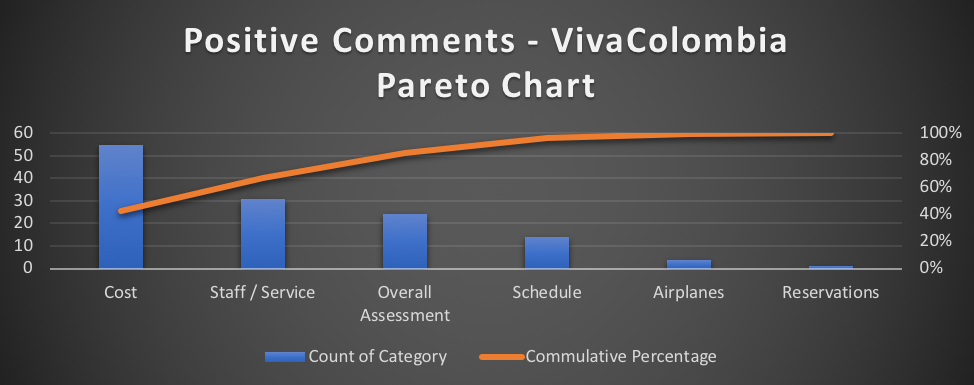
Positive reviews. Categories: cost, staff/service, overall assessment, schedule, airplanes, and reservations. Cost was the most frequent category (43% of positive reviews), reflecting a clear “getting what you paid for” sentiment — not negative, but an understanding of the airline’s value proposition and a positive read on it.
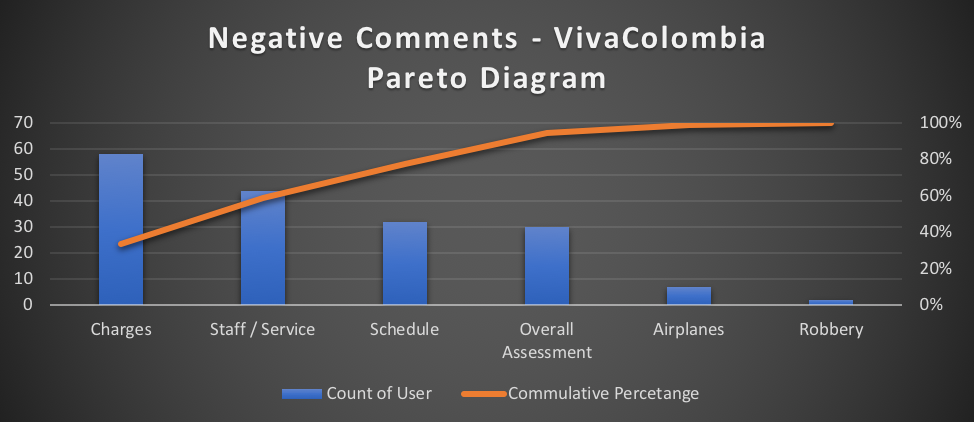
Negative reviews. Categories: charges, staff/service, schedule, overall assessment, airplanes, and theft. Charges ranked highest in frequency, consistent with the broader case: VivaColombia operates in an emerging market where the traditional airline model is still the norm, and when charges hit customers who don’t fully understand the low-cost model, satisfaction drops.
Affinity ideas generated around the charges category included:
- Are we communicating our charge structure clearly enough?
- Does the website need to change?
- Is there a problem with our check-in procedures?
- Are customers feeling misled?
- Are charge issues handled consistently across employees?
- How strong is staff communication?
- Is the website communicating effectively?
- Are luggage charges clear?
These grouped into four categories: check-in procedures, website, staff communication, and luggage charges.
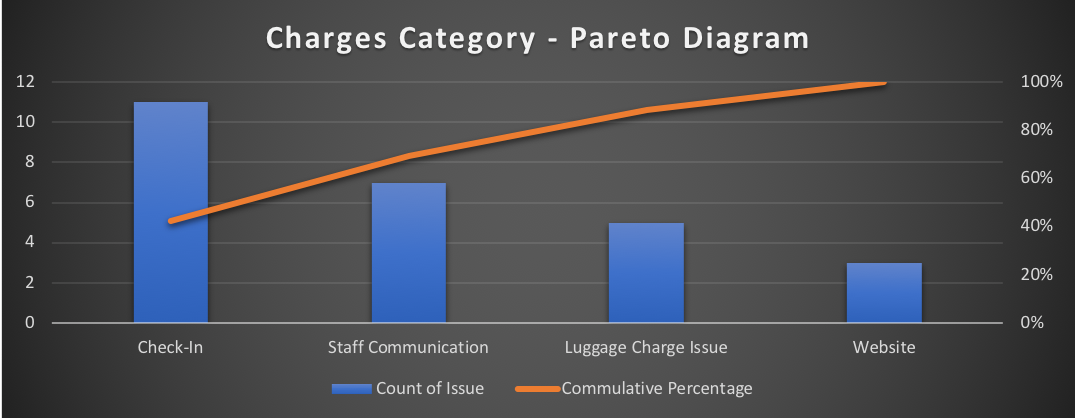
Recommendation. VivaColombia should look closely at check-in procedures and how staff communicate with customers — over 40% of charge-related complaints involved an unexpected check-in fee when a customer printed their boarding pass at the airport, which points to a clarity and transparency issue, even though VivaColombia states that all potential fees are disclosed on its website at the point of booking. Over 20% of charges complaints related to how staff communicated with customers. Notably, customers weren’t complaining much about the website itself — which suggests either the value proposition isn’t being communicated as intended, or customers aren’t reading the website information carefully (if at all), which in turn may be feeding the staff-communication complaints.
Quality and process improvement
Staff/service and schedule were the next two categories driving negative sentiment, and both trace back to the same growing pains behind the charges complaints.
Quality model. Service quality can be assessed across three factors: conformance quality (how the service is delivered), performance quality (what customers actually prefer), and communication quality (what customers expect).16 For VivaColombia, communication quality stands out as needing the most attention — the TripAdvisor analysis suggests the charge structure wasn’t being communicated effectively, and that gap was dragging down satisfaction. When conformance quality slips, it directly damages customer expectations, and when expectations aren’t managed well, customers end up disappointed because what they get doesn’t match what they expected. These three factors are tied together in a continuum, and most quality problems trace back to a gap between them.
Process improvement examples from the industry. Two examples of how airlines have used process improvement to raise efficiency:
- Catering inventory. US Airways adopted lean, just-in-time production for catering, reducing inventory across its commissaries, improving catering accuracy on aircraft, and increasing stocking consistency — in part just by having the same employee stock the same drawers each time.17
- Baggage handling. Auckland International Airport used a simple lean six sigma approach — opening cargo doors and pulling bags as soon as the plane is on blocks, even before passengers start deplaning — cutting five minutes off turnaround across millions of passenger trips, with meaningful cost savings for both the airport and the airlines operating there.18 The same kind of change lowers parking and air-conditioning costs while a plane is unloading, while also shrinking turnaround time and reducing scheduling issues.
Conclusion
The case closes at the December 2015 board meeting, where VivaColombia had to decide between expanding into Brazil or consolidating locally — both options carrying the same $1 million upfront cost.
Option 1: Expand into Brazil. High risk, high reward. VivaColombia had already secured the flight-route permits needed for Brazil, so operations there could have started quickly.19 Brazil also looked like a promising growth market, where VivaColombia could establish itself as the preferred low-cost carrier on the Bogotá–São Paulo route.20
Option 2: Consolidate locally. Lower risk, lower reward — but the efficiencies gained from consolidation were seen as integral to the company’s ability to keep developing over time.
Recommendation. Expanding into Brazil would have required a broad set of changes — hiring more staff in Brazil and purchasing a different aircraft type (the Airbus A350-800 XWB) suited to the cabin space and comfort needed for long-haul flights, since an A320 wouldn’t hold up well on routes of that length. Changes on that scale would have further disrupted the business as it tried to expand into a new market, risking the health of the existing Colombia-based operation.
Consolidating locally was in VivaColombia’s best interest — solidifying its market position and addressing customer dissatisfaction. Market research suggested consolidation would cut customer dissatisfaction by 15%, translating into demand roughly doubling year over year for the following three years; failing to consolidate would have left satisfaction flat, with demand growth stuck around 8% year over year over the same period. With new low-cost entrants coming into the Colombian market, that advantage mattered.
VivaColombia today
The board chose to consolidate operations locally and explore other ventures that complemented its business goals, and VivaColombia went through significant change between 2015 and 2017. In June 2016, Irelandia Aviation acquired an additional 50% equity stake, bringing its total participation to 75% and giving founder Declan Ryan significant influence over the company’s direction going forward — the remaining 25% was held by Grupo Iamsa.21 William Shaw stayed on as CEO, while co-founders Posada and Migowski left the company. In August 2016, VivaColombia announced plans to launch a low-cost airline in Peru under the name Viva Air Peru,22 and in 2017, under the Viva LatinAmerica Group umbrella, management outsourced fleet maintenance to AAR.23 William Shaw remained CEO of Viva Air until January 2018, when Declan Ryan took over — announcing that the airline would continue its expansion following the prior year’s $5.3 billion order for 50 new Airbus A320 aircraft, with deliveries beginning in the second half of 2018.24
VivaColombia grew from transporting 550,000 passengers in 2012 to over 3.5 million in 2017, gaining market share and expanding internationally to the United States, Peru, and Panama. With 50 new A320s on order, the airline still has room to grow — provided it keeps reducing its service variability, communicating its value proposition more clearly, and finding ways to deliver higher service quality at a lower cost.
Sources and notes
Footnotes
-
In 2010, VivaColombia petitioned Colombia’s Aerocivil authority for the permit to operate a low-cost airline business model; the permit was granted later that year, and the first three A320s were delivered in March 2012. ↩
-
Aerocivil’s permit only allowed one year to begin servicing new routes after it was granted. ↩
-
VivaColombia: The Challenge of Growing a Low-Cost Airline in Latin America (pp. 3–4). ↩
-
semana.com — “VivaColombia: un caos, un modelo de negocio” ↩
-
See “How VivaColombia responded to service variability” for details on the fare classes. ↩
-
Airbus newsroom — Viva Air commits to 50 A320-family aircraft ↩
-
Frances X. Frei, Breaking the Trade-Off Between Efficiency and Service (2006). ↩
-
VivaColombia: The Challenge of Growing a Low-Cost Airline in Latin America (pp. 6–7). ↩
-
Navitaire’s platform included a Global Distribution System (GDS) connecting VivaColombia to major online travel agencies. ↩
-
PR Newswire — AAR signs component support agreement with Viva Colombia and Viva Air Peru ↩
-
Negative review share by year: 2016 = 33%; 2017 = 47%; 2018 YTD = 69%. ↩
-
Dr. Phillip Lederer, Lecture #7: Quality & Process Improvement (2018). ↩
-
Lean Six Sigma Belgium — ways lean airline companies improve their services ↩
-
Lean Six Sigma Belgium — ways lean airline companies improve their services ↩
-
Route permits can take up to a year to secure, and are typically valid for one year if the airline hasn’t yet begun operating the route — subject to renewal if the route is in use, or forfeited if it isn’t. ↩
-
Only major carriers — Copa Airlines, LATAM, and Avianca — were flying the Bogotá–São Paulo route at the time. ↩
-
La República — Irelandia Aviation increases its stake in VivaColombia ↩
-
Viva Air Peru began operations in mid-2017. ↩
-
Reuters — AAR Corp enters agreement with Viva Colombia and Viva Air Peru ↩
-
Finance Colombia — Declan Ryan replaces VivaColombia founder William Shaw as president of Viva Air ↩
Working through this at your own organization?
Keep reading