200+ Single Audits supported
A Single Audit is survivable. The habits that make it survivable get installed months before the auditors arrive.
Uniform Guidance readiness for Puerto Rico nonprofits drawing federal awards: personnel documentation under 2 CFR 200.430(i), the Schedule of Expenditures of Federal Awards, subrecipient monitoring, indirect cost rates, and the corrective action plan for whatever came up last cycle.
Bring your last management letter. We will read the findings and tell you which ones will repeat.
Symptoms
If any of these is your week, this page is for you.
These are the sentences people actually say on the first call, in roughly the order we hear them.
- 01
“We crossed the Single Audit threshold and nobody here has been through one.”
- 02
“We got a finding on time-and-effort documentation. It is a repeat.”
- 03
“Payroll allocation across seven awards lives in one spreadsheet, on one laptop, and she is retiring in March.”
- 04
“Our SEFA is assembled by hand in the last two weeks and we are never sure the totals tie to the general ledger.”
- 05
“We pass money through to three subrecipients and I could not tell you when we last monitored any of them.”
- 06
“Our indirect cost rate proposal is due and we are still on the de minimis rate because nobody had time to build one.”
- 07
“The auditors asked for support for personnel costs charged to the award, and what we sent was a budget estimate nobody ever trued up.”
Every one of those is a documentation problem before it is an accounting problem. That is the order we fix them in.
The engagement
What the first ninety days look like.
Not a framework. The actual sequence, on the actual calendar, with the week you hear bad news marked.
- 01
Week 1 — We read the file before we say anything
Your last two audit reports, including the Schedule of Findings and Questioned Costs. Your current award agreements and their terms. Your chart of accounts and how awards map to it. Your payroll register and how salaries are allocated today. Your subrecipient agreements, if you have any.
You get one written page at the end of week one: what we found, what is a real audit exposure, and what is fine. If your books cannot survive an audit, you hear it in week one, not in the management letter.
- 02
Weeks 2–4 — Personnel costs first
Payroll is the largest line in most nonprofit budgets and the one that produces the most questioned costs. We establish how hours are recorded, how they map to awards and activities, and whether the records meet the 2 CFR 200 documentation criteria: incorporated into the official payroll records, supported by an internal control system, reflecting the total activity the employee is compensated for, and covering federally assisted and non-federal work in the same integrated way.
Where budget estimates are being used for interim charging, we establish the after-the-fact review that trues them up. That is the step organizations most often skip and auditors most often find.
- 03
Weeks 4–8 — The rest of the record
Subrecipient monitoring: risk assessment, the monitoring schedule, and what evidence you keep. The SEFA: built from the general ledger on a repeatable basis, not assembled from memory in the last two weeks. Indirect costs: whether a negotiated rate is worth building for your award mix, or whether the de minimis rate is genuinely the right call for you.
- 04
Weeks 8–12 — The dry run
We assemble the sample an auditor would ask for and test whether you can produce it. Where you cannot, we fix the process rather than the sample. Then we write the corrective action plan for any prior findings in the form the auditor expects to receive it.
- 05
During fieldwork — We are in the room
We handle the auditor requests, keep the tracking list current, and answer questions in your terms. Your team is not translating between the auditor and the bookkeeper.

The standing rule
We prepare you for the audit. An independent CPA firm performs it.
We cannot be both, and you do not want a firm that offers to be.
Deliverables
Physical outputs, not guidance.
Seven things that exist on paper, in your systems, and in your procedures when the engagement closes.
- A written readiness assessment against Uniform Guidance requirements, keyed to your specific awards.
- A personnel documentation procedure written for your organization, with the internal controls named. Not a template.
- A time-and-effort record that satisfies 2 CFR 200.430(i), produced by FTE Tracker if you deploy it or by your existing payroll system if it can carry the load. We will tell you honestly which.
- A SEFA prepared from the general ledger, with the reconciliation that supports it.
- A subrecipient monitoring plan, with the risk assessment and the schedule behind it.
- A corrective action plan for each prior finding, in the format the auditor expects.
- One point of contact during fieldwork, who has read your file.
Where software carries it
The readiness checks, run before anyone asks for them.
Missing certifications, allocations that do not total 100%, leave with no basis, periods nobody closed. FTE Tracker runs those checks continuously and exports the audit pack as files your independent auditor can open without a call.
Deploying it is not a condition of the engagement. If your payroll system already produces records that meet the 2 CFR 200 criteria, we will tell you so and leave it where it is.
How the audit pack is built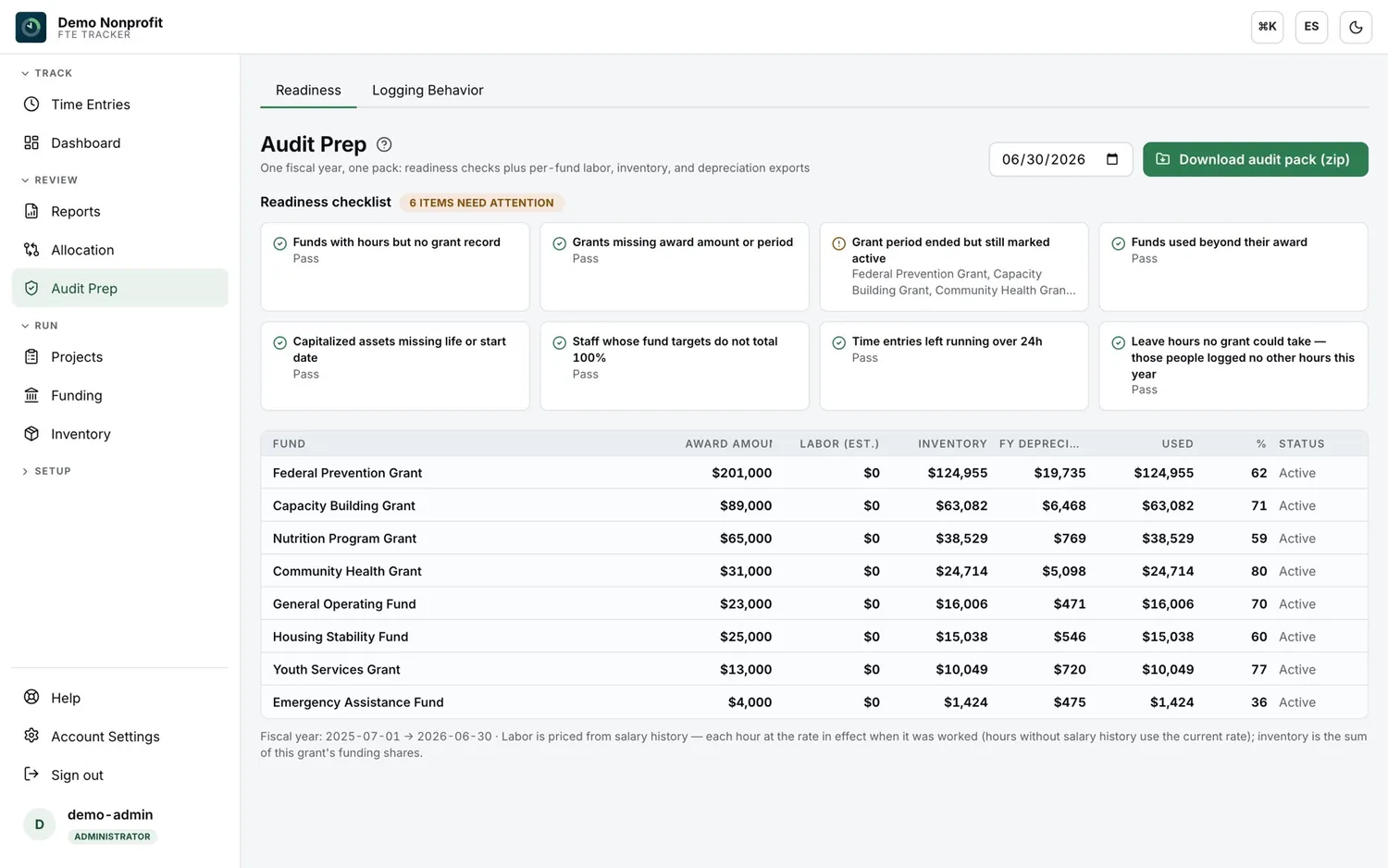
Questions
What people ask on the first call.
Scope and fee depend on your award count, your headcount charged to those awards, and whether you carry open findings. We quote after the week-one read, never before it.
Do you replace our accountant or our auditor?
Neither. Your independent auditor cannot also be your consultant. That independence is the entire point of the audit, and any firm offering to do both should worry you. Your bookkeeper or controller usually stays; we work alongside them and, in most engagements, make their job smaller. If you would rather hand the whole finance function over, that is a different engagement.
We already have a finding. Is it too late?
No, and a repeat finding is the thing to avoid now. The corrective action plan you filed is a commitment the auditor will test against next cycle. We start by reading what you promised, then build the process that actually delivers it. Organizations that get a second finding on the same issue usually filed a plan nobody operationalized.
How long before we are ready?
Ninety days is the honest number for an organization with clean books and no open findings. With a repeat finding on personnel costs, plan on a full cycle. You need a period of records produced the right way, not a policy document written the right way.
Do we have to use your software?
No. FTE Tracker exists because most nonprofits allocating salaries across many awards cannot do it defensibly in a spreadsheet. If your payroll system already produces records that meet the 2 CFR 200 criteria, we will say so and leave it alone.
Can you work in Spanish?
Yes. Engagements run in Spanish or English, including staff training and system documentation. Training materials are in Spanish because that is the language the staff entering the data work in, while the reporting that goes to the auditor and the federal agency goes out in English.
Bring us your last management letter.
Thirty minutes. We read the findings, tell you which ones will repeat, and give you a rough sequence for the next ninety days. No charge and no deck.
Or call the Puerto Rico office: +1 (787) 241-9147