Assess · implement · support
Systems that make compliance a byproduct of doing the work.
Assessment, implementation and ongoing support for the software a grant-funded organization runs on — case records, CRM, accounting, and the time-and-effort system that feeds them. Run by the same firm that sits in your audit, so the reports you need come out of the systems instead of out of somebody’s December.
Thirty minutes. Bring the report that takes longest to produce.

Where this starts
Five sentences we hear on the first call.
- 01
“Our case records are in one system, our payroll is in another, and the grant report is assembled by hand from both.”
- 02
“We bought software two years ago and half the staff still keep their own spreadsheet.”
- 03
“Every funder wants a different report and each one takes a week to produce.”
- 04
“The person who set up our accounting system left and nobody knows why it is configured this way.”
- 05
“We need a new case management system and the implementation quote is more than the software.”
The engagement
Assess, implement, support.
Three stages, and we will tell you at the end of the first one if the answer is that you should change nothing.
- 01
Assess
We map what you have: the systems, who uses them, what data lives where, and which reports are produced by hand. Then we map what you are required to produce — funder reports, board reports, the personnel documentation your federal awards require — and find the gap between them.
The output is a written assessment naming which system is the real constraint. Often it is not the one people complain about. Occasionally the finding is that your software is fine and your process is the problem, which is cheaper news than it sounds.
- 02
Implement
Project management is the part that fails, not the software. We run the implementation: the configuration, the data migration, the parallel period, and the internal communication that decides whether staff adopt the system or route around it.
We take the coordination load off your team and keep your stakeholders informed, because an implementation nobody was told about is an implementation nobody uses.
- 03
Support
Systems drift. Staff turn over, awards change, a funder introduces a new report. We stay on afterward for configuration changes, new reports, training for new hires, and the periodic check that the system still matches how the organization actually works.

The software we built, and still run at 2am.
FTE Tracker is federal time-and-effort documentation: hours logged against the awards that pay for them, priced from each employee’s salary history, certified and exported in the form an independent auditor asks for under 2 CFR 200.430(i). It has been in continuous production at federally funded Puerto Rico nonprofits since 2018.
That is the difference between a firm that implements software and a firm that ships it. When a record does not reconcile, we do not open a support ticket with somebody else.
See the full product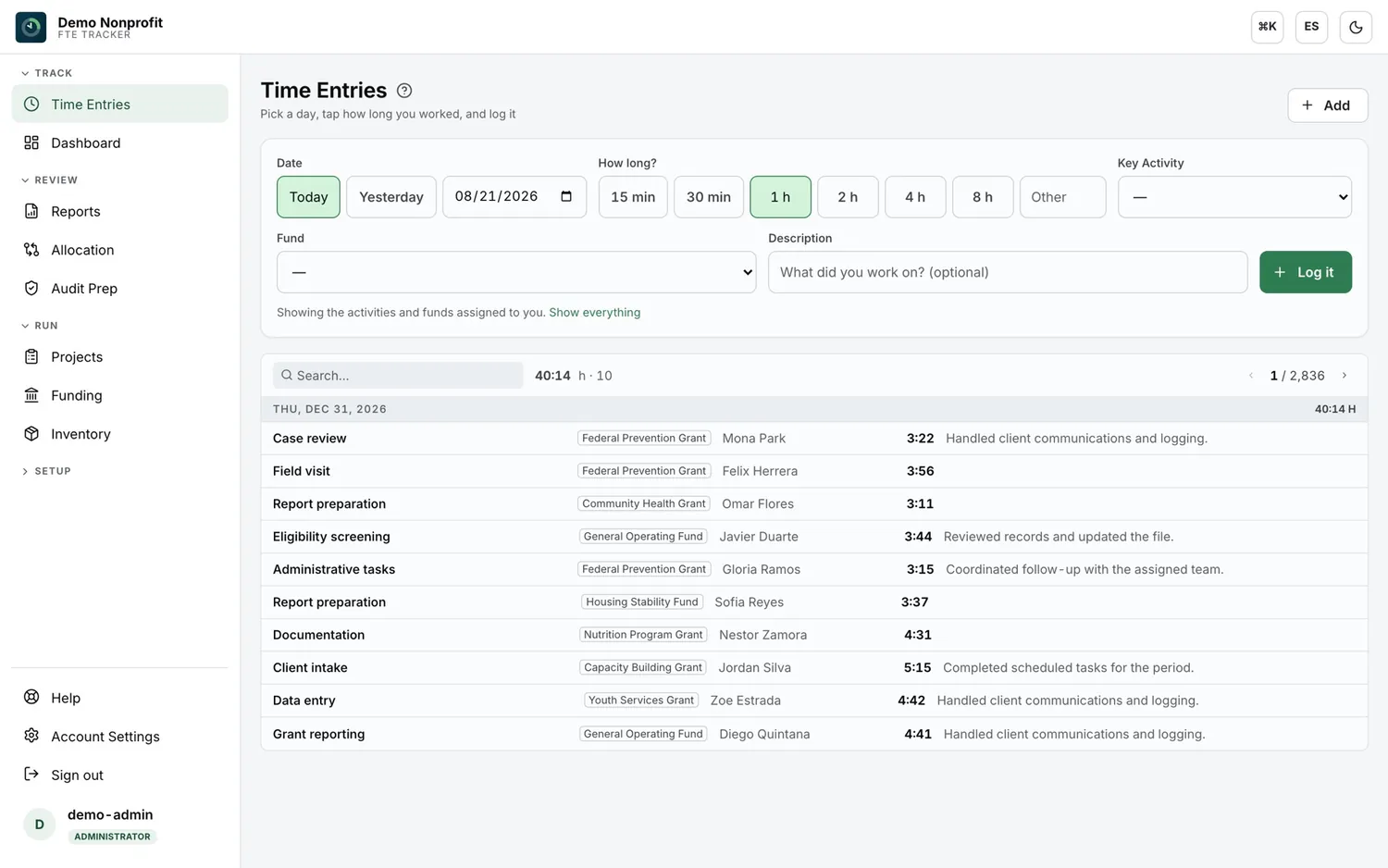
What we deploy
An honest inventory.
One system is ours. The rest are open-source products we configure, migrate onto, train your staff on, and maintain afterward — chosen because they fit the organization, not because we resell them.
- FTE Tracker
- time and effort · ours
- SuiteCRM
- donor · participant · partner
- Odoo
- billing · accounting · inventory
- Hosting
- AWS · DigitalOcean · Rackspace
Hosting environments we implement in — not partnerships, and not credentials. We will tell you which one your organization should be in and why, and the answer is sometimes the one you are already paying for.
Build vs. buy
Web and application work, scoped honestly.
We build web applications, and FTE Tracker is the proof of what that means at the serious end. We also build websites, configure organizational email and set up hosting — real work, done well, and not why a nonprofit hires this firm. We are not going to sell you a website when your problem is a repeat audit finding.
Custom web applications where an off-the-shelf system genuinely does not fit — grant-specific data collection, reporting portals, participant-facing tools. Reporting layers over systems you already run. Organizational websites, hosting and email configuration.
Anything where a configured open-source system does the job. Building is more expensive than configuring in every year after the first one, and the year after the first one is when the person who commissioned it has moved on.
Why a compliance firm does implementation work
Because the reports come out of the systems. An organization whose case records, payroll and grant ledger do not reconcile will produce its federal reporting by hand every period, and hand-assembled reporting is where reconciliation errors and questioned costs come from. Fixing the systems is usually cheaper than staffing around them, and it is the only version of the fix that survives the person who currently holds it together leaving.
Questions
What people ask before they commit.
Do you charge for the systems themselves?
The open-source systems are free; you pay for hosting, configuration, implementation and support. FTE Tracker is a subscription. We break out which is which before you commit to anything.
What happens if we already started an implementation and it has stalled?
That is a common call. We assess where it actually is rather than where the plan says it is, and tell you whether to finish it, restart it, or stop.
Can you work with our current IT vendor?
Yes. We are usually the ones who understand what the funder requires and they are the ones who understand your infrastructure. That division works fine as long as somebody owns the reporting requirements, and if nobody does, we will.
Federal compliance
The audit-side work the systems have to feed: time and effort, subrecipient monitoring, the SEFA, and the readiness that comes before fieldwork.
02Outsourced finance
Close, payroll, grant allocation and reporting, run as your finance department on a calendar you can hold us to.
Describe your stack in thirty minutes.
Tell us what systems you run, which report takes the longest to produce, and who leaves the organization next year. We will tell you where the real constraint is — and if it is a process rather than a product, we will tell you that instead of quoting you an implementation.
Or call the Puerto Rico office: +1 (787) 241-9147