In continuous production since 2018
Your personnel costs, documented to the standard federal auditors actually apply.
FTE Tracker is the time-and-effort system we built for our own clients and still operate today. Behind it, Pecunia Group runs the finance function that keeps the whole award defensible — for Puerto Rico nonprofits, in English and Spanish.
No sales deck. We will ask what is actually at risk and tell you what we would do about it.
- 100,000+time-and-effort entries managed
- 250+projects and awards tracked
- 200+Single Audits supported
- 15 yearsin practice, founded 2011
Why one firm
CPA firms do not ship software. Software vendors do not sit in your audit.
Most nonprofits carrying federal awards end up managing two vendors who blame each other. The accountants say the personnel documentation is inadequate. The software company says the system does what it was configured to do. In the middle is a Schedule of Findings and Questioned Costs with your organization’s name on it.
We do both halves. We run the finance function — the close, the payroll, the Schedule of Expenditures of Federal Awards — and we built and still operate the time-and-effort system that produces the payroll documentation your auditors ask for under 2 CFR 200.430(i). When a question comes back from the field, one team has both answers, and neither half can point at the other.
How an engagement actually runsInside FTE Tracker
Four things it does that a timesheet cannot.
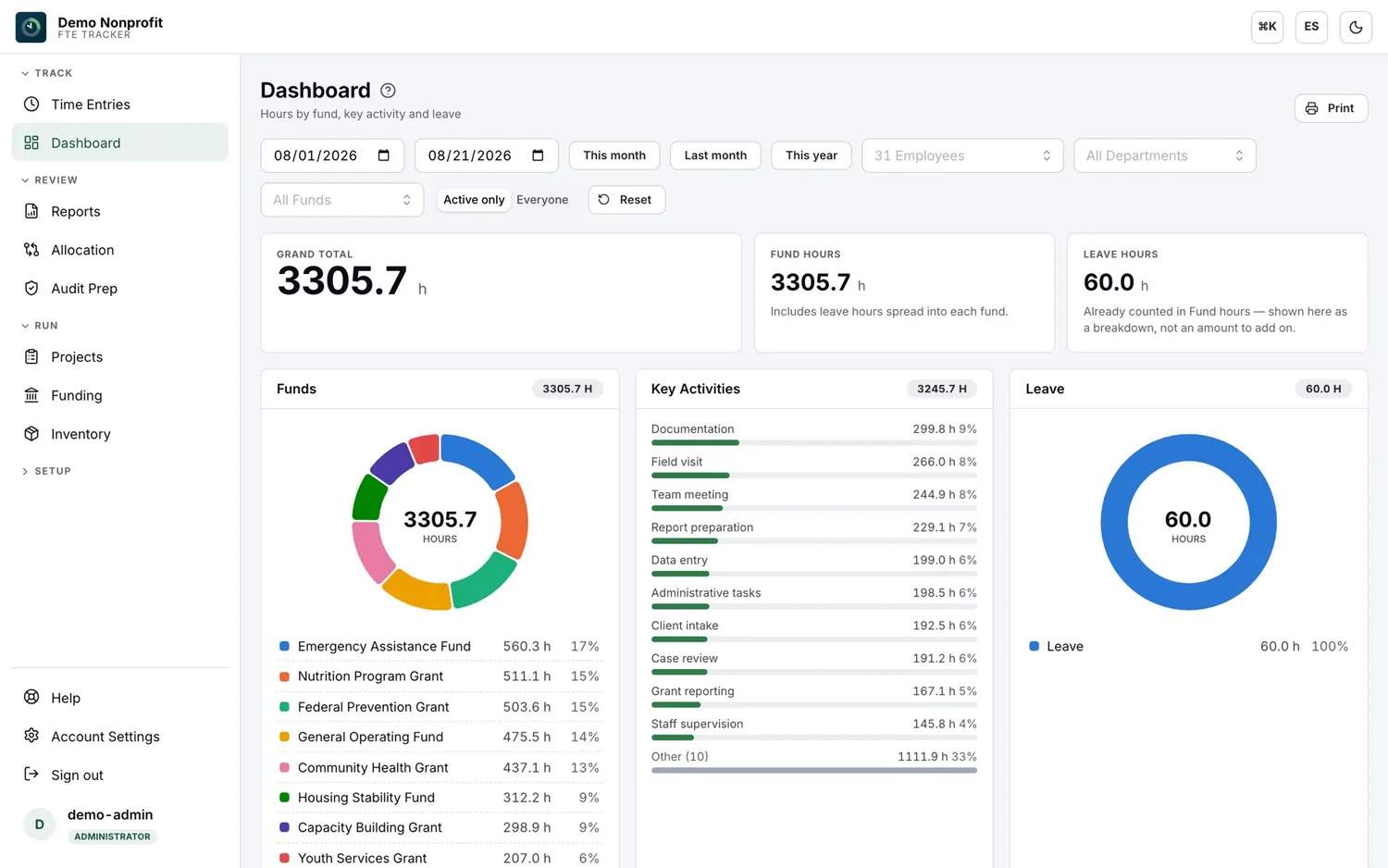
Screens from a working deployment, shot against a demonstration organization. No client data appears anywhere on this site.
See the drift before the auditor does.
Every employee carries a target split across the awards that fund them. The allocation view puts the target beside what actually happened, so a program officer’s 40% that has quietly become 12% surfaces in month two — not in the management letter.
How allocation reporting works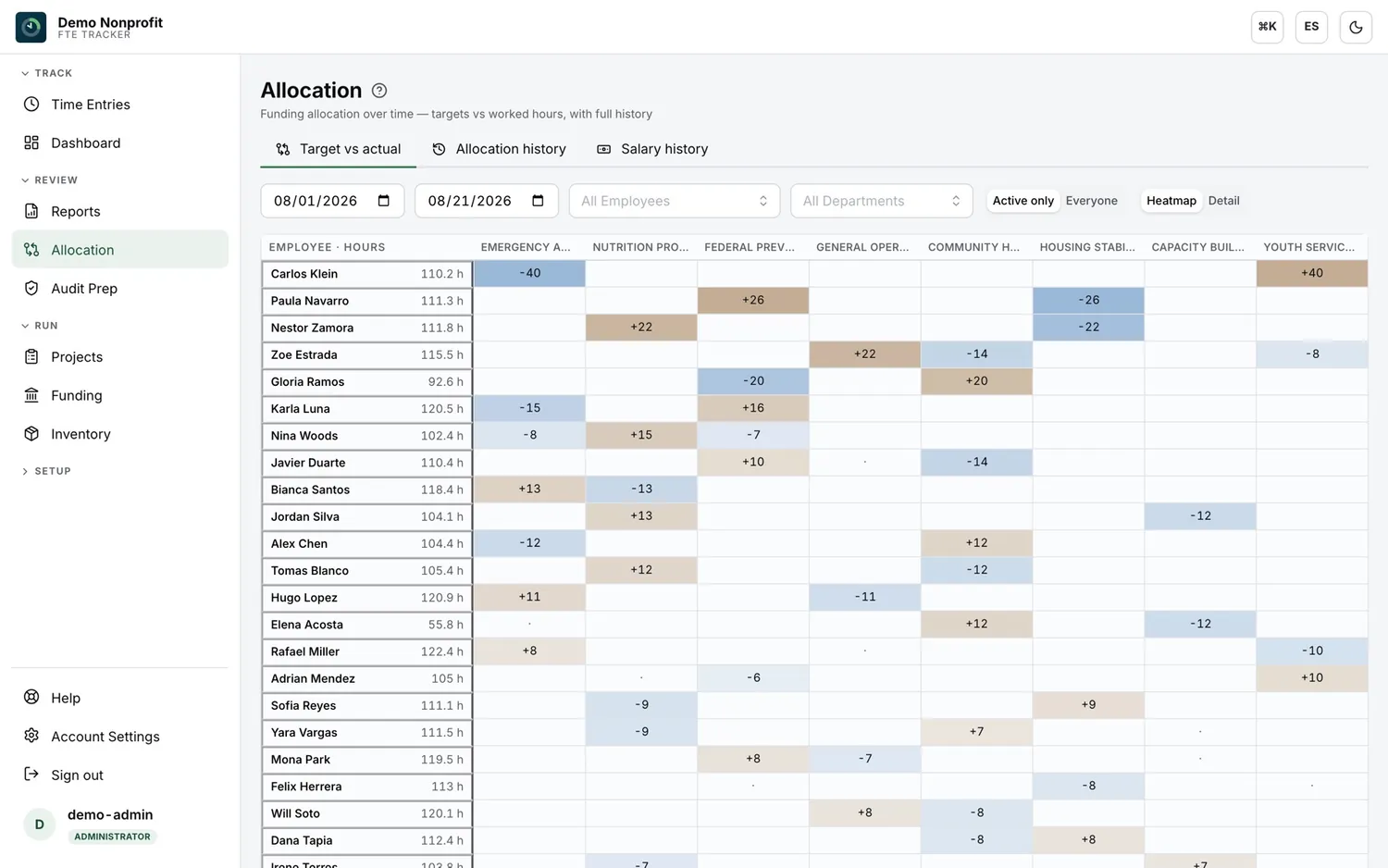
Labor priced from the salary history, not from a guess.
Hours become dollars using each employee’s salary as it stood on the day the work happened, including raises mid-period. Utilization against each award is a read of the same numbers your ledger already carries.
What the grant module reports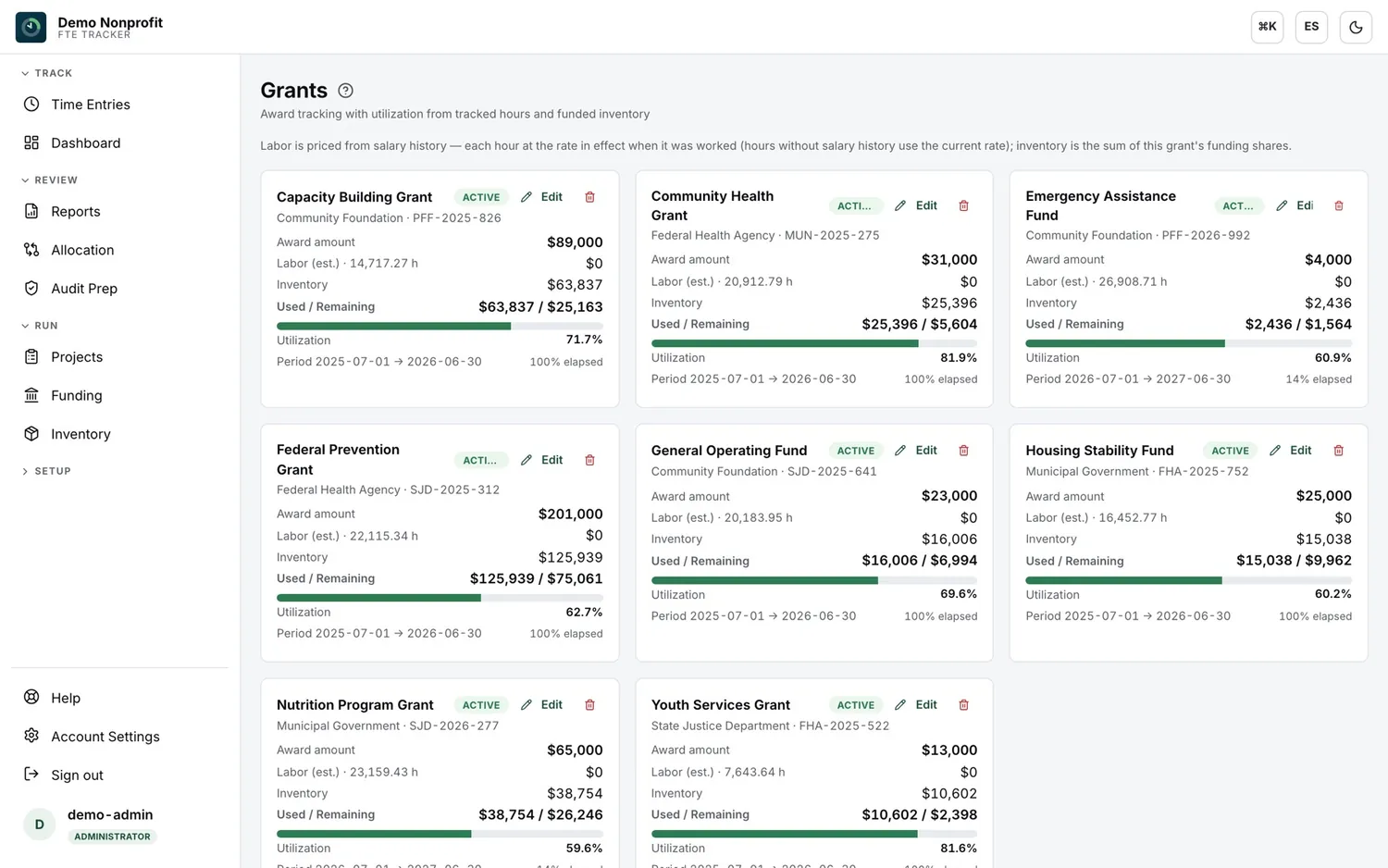
The readiness checks, run before anyone asks.
Missing certifications, allocations that do not total 100%, leave with no basis, periods nobody closed. The audit pack exports as a CSV bundle your independent auditor can open without a call.
Single Audit readiness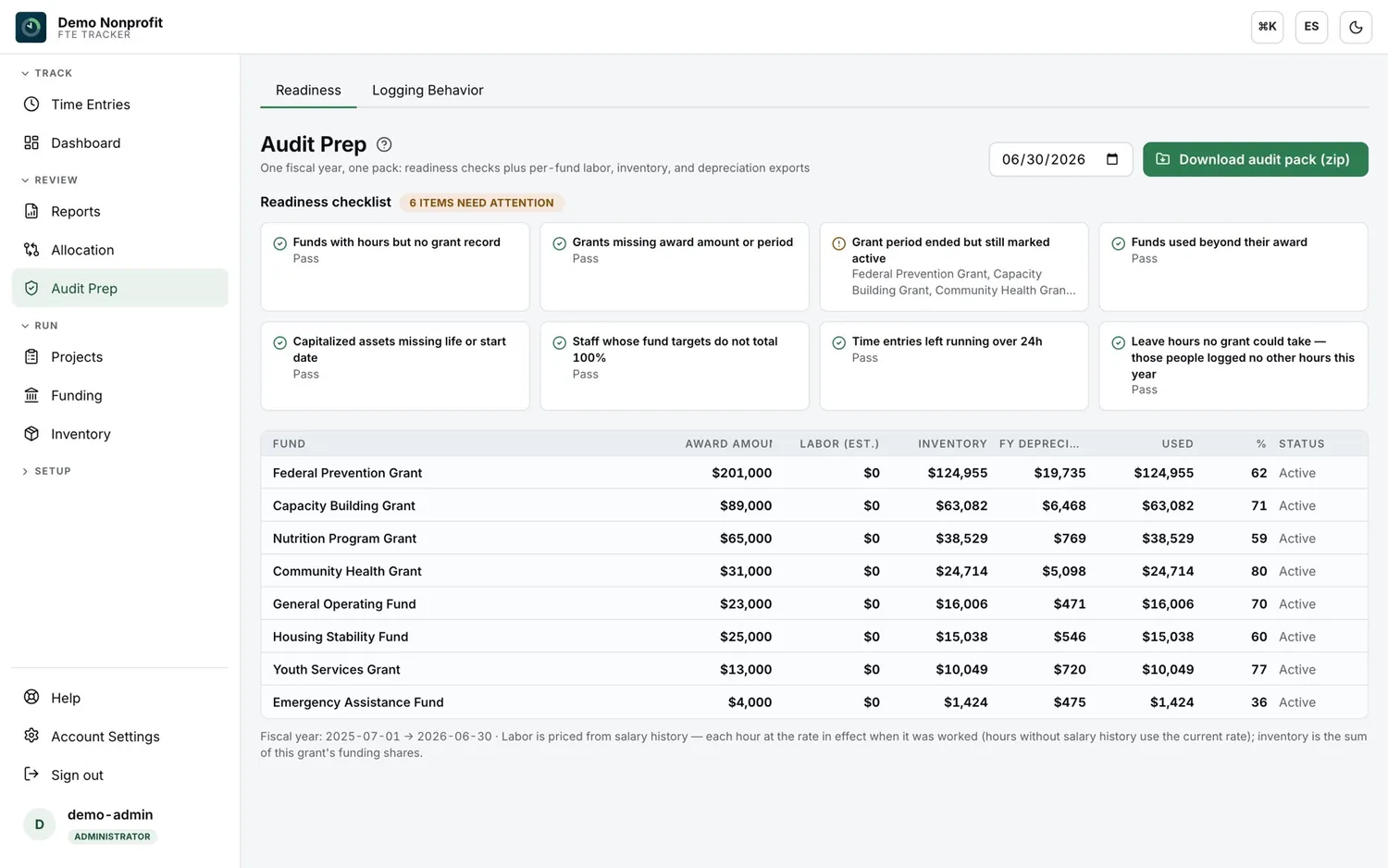
After-the-fact estimates are the finding. This shows you who is drifting toward one.
The distance between when work happened and when it was logged, per person. Fifteen chronic late loggers is a training problem you can fix in a week. Discovering it during fieldwork is a questioned cost.
See the full product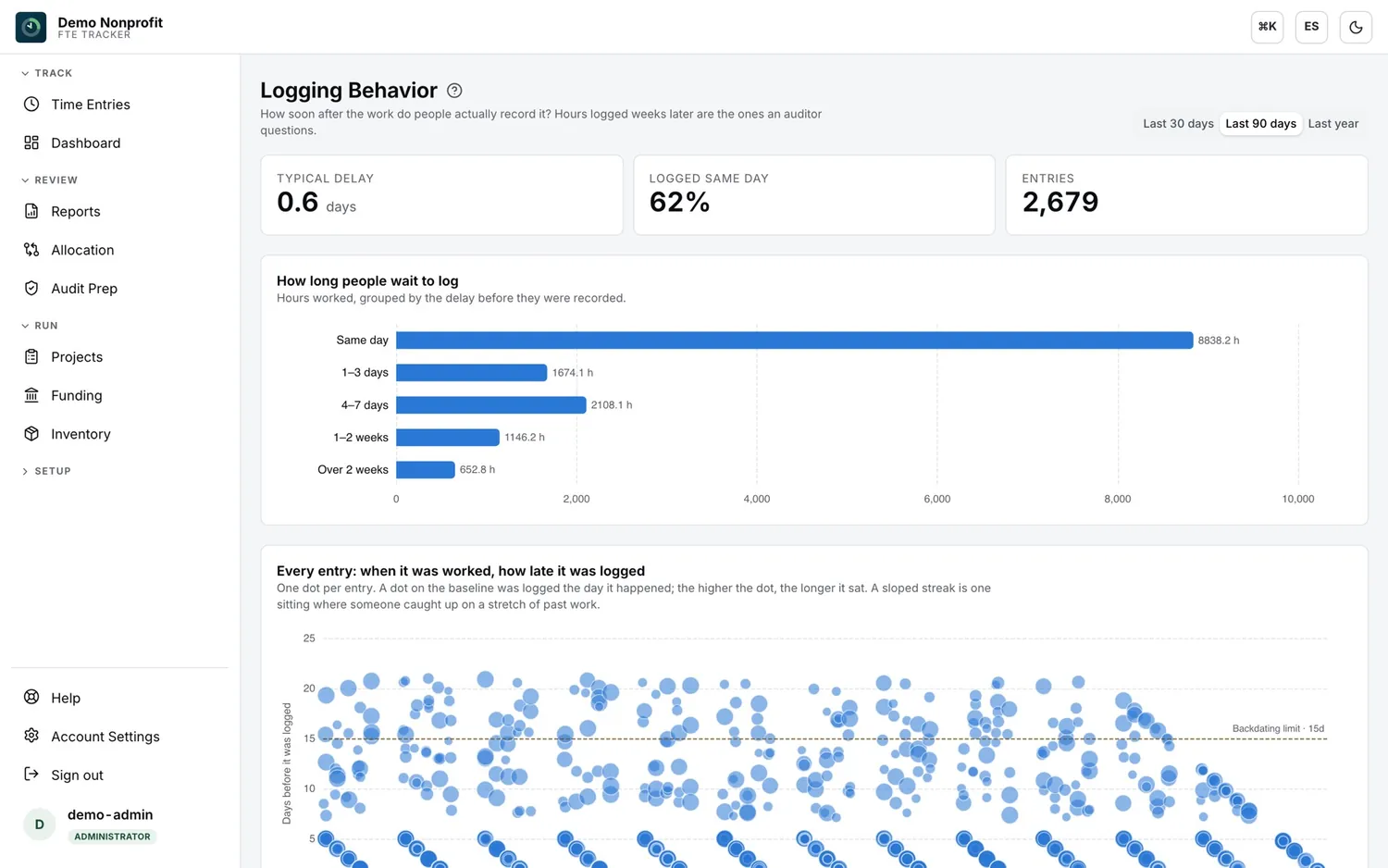

Who this is for
Organizations where a questioned cost is not an accounting problem. It is a program that stops.
The practice
Whatever is keeping you up, it is probably one of these three.
The software is one half of the answer. This is the other half — the people who run the function it reports on.
- 01
Your Single Audit is in six months and the personnel documentation will not hold.
Time and effort, subrecipient monitoring, the SEFA, the indirect cost rate, and the corrective action plan for whatever came up last cycle. We install the documentation habits months before the auditors arrive, then stay in the room while they are there.
Federal compliance and Single Audit readiness - 02
Your books close six weeks late and the board found out.
Bookkeeping, payroll, grant allocation, monthly close, and the reporting your program officers and your board each need in a different format. We run it as your finance department, on a calendar you can hold us to.
Outsourced finance - 03
Your payroll system, your grant ledger and your case records do not talk to each other.
Systems assessment, implementation, and the support afterward — including the health and social-services record systems nonprofits in this sector actually run. Compliance becomes a byproduct of doing the work, not a second job someone does in December.
Systems and implementation
Proof of record
Numbers, and where each one comes from.
Figures a visitor can check themselves are marked verified. Firm-wide figures attested by the founder are marked as such. Nothing here is rounded up from a guess.
| Figure | What it measures | Where | Status |
|---|---|---|---|
| Since 2018 | FTE Tracker in continuous production at federally funded Puerto Rico nonprofits | /fte-tracker/ | verified |
| 100,000+ | time-and-effort entries managed across FTE Tracker deployments | /fte-tracker/ | attested |
| 250+ | projects and awards tracked across FTE Tracker deployments | /fte-tracker/ | attested |
| 200+ | Single Audits supported | /federal-compliance/ | attested |
| 939 | Puerto Rico nonprofits in the public directory we maintain | /nonprofit-directory/ | verified |
| 15 | years in practice, founded 2011 | /about/ | attested |
From the firm
Writing on federal compliance and nonprofit finance.

- 2019-07-17 Internal Controls in Nonprofit Organizations
- 2019-07-02 Time and Effort Reporting: Documentation for Nonprofit Organizations
- 2019-06-12 The Importance of Project Management for Nonprofit Organizations
Federal guidance changes. If you are reading a piece more than a year after it was published, call us before relying on it.
Find out where you actually stand.
Thirty minutes. We look at what you are carrying — a Single Audit on the calendar, a close that is always late, a system nobody trusts — and tell you plainly what we would do first.
No charge, no deck. Bring your last management letter if you have one.
Or call the Puerto Rico office: +1 (787) 241-9147