Nonprofit finance for 15 years
Your finance department, audit-ready every day of the year.
Fund accounting, payroll with award allocation, a monthly close on a date you can hold us to, and CFO-level advisory. Run by a team that already speaks Uniform Guidance, so the books are never a scramble in March.
Tell us how many funding streams you carry and how late the last close was. That is the whole intake.
Symptoms
What a finance function running short of itself sounds like.
None of these is an accounting failure on its own. Together they are a function that cannot answer a question in the week the question is asked.
- 01
“Our books close two to three weeks late, every month.”
- 02
“The board meets with numbers that are six weeks old and decides using them.”
- 03
“Payroll allocation across seven awards lives in one spreadsheet and one person’s head.”
- 04
“We do not have anyone in-house who understands grant-fund accounting.”
- 05
“We cannot get a straight answer on where we stand financially between audits.”
- 06
“Our bookkeeper is good, but we need someone who can also talk to the board.”
What we take on
The whole function, or the piece that is missing.
We scope after intake and quote a fixed monthly fee against volume, funding streams, and whether payroll is included. No hourly surprises.
- 01
Transition — 30 to 60 days, with one close run in parallel
System access, a review of your chart of accounts against how your funders actually require you to report, and the fund structure rebuilt where it does not carry awards cleanly. We run one month in parallel with whoever closes today before we take the keys.
If you are in the middle of fieldwork, we wait for it to finish. Changing hands mid-audit is a risk nobody is being paid to take.
- 02
Monthly — the close, on a date you can hold us to
Bank and grant reconciliations, the general ledger closed on a committed date, and a board package a non-financial trustee can read without a translator. Budget-to-actual by award, not just in total.
- 03
Payroll — allocated by award and activity, then reconciled
We process payroll and allocate those salaries across awards and activities, then reconcile that allocation against the time-and-effort record required by 2 CFR 200.430(i). Two records that have to say the same thing. Most findings we see are the month somebody stopped checking that they did.
- 04
Ongoing — CFO-level advisory, in the room where it is decided
Annual and per-award budgets, cash flow planned around reimbursement-based federal funding, the indirect cost rate proposal, and a second set of eyes on the numbers before your board and finance committee see them.
- 05
Audit cycle — we assemble the file and answer the questions
The auditor request list, the supporting files, and the answers during fieldwork. Because we kept the record all year, this stops being a season and starts being a week.

What actually changes
The month closes on the date we gave you, including the months that were hard.
Deliverables
When the work goes right, this is what stays installed.
Written artifacts and running routines, not a relationship you cannot document.
- A close calendar with committed dates and a named owner on every line.
- Monthly bookkeeping and reconciliation, with the support file sitting behind each transaction.
- Payroll processed and allocated by award and activity, reconciled to the time-and-effort record.
- Monthly and quarterly reporting a non-financial board member can read, in English or Spanish.
- Budget development and budget-to-actual tracking by award, not only in total.
- A written procedures manual, so the function does not depend on anyone’s memory, including ours.
- A finance function that is already documentation-ready the day a Single Audit lands on the calendar.
Where the two records meet
Labor priced from the salary history, then charged to the award that funded it.
Hours become dollars using each employee’s salary as it stood on the day the work happened, raises mid-period included. Utilization against each award is a read of the same numbers your general ledger already carries, which is what makes the allocation defensible rather than merely plausible.
How the grant module reports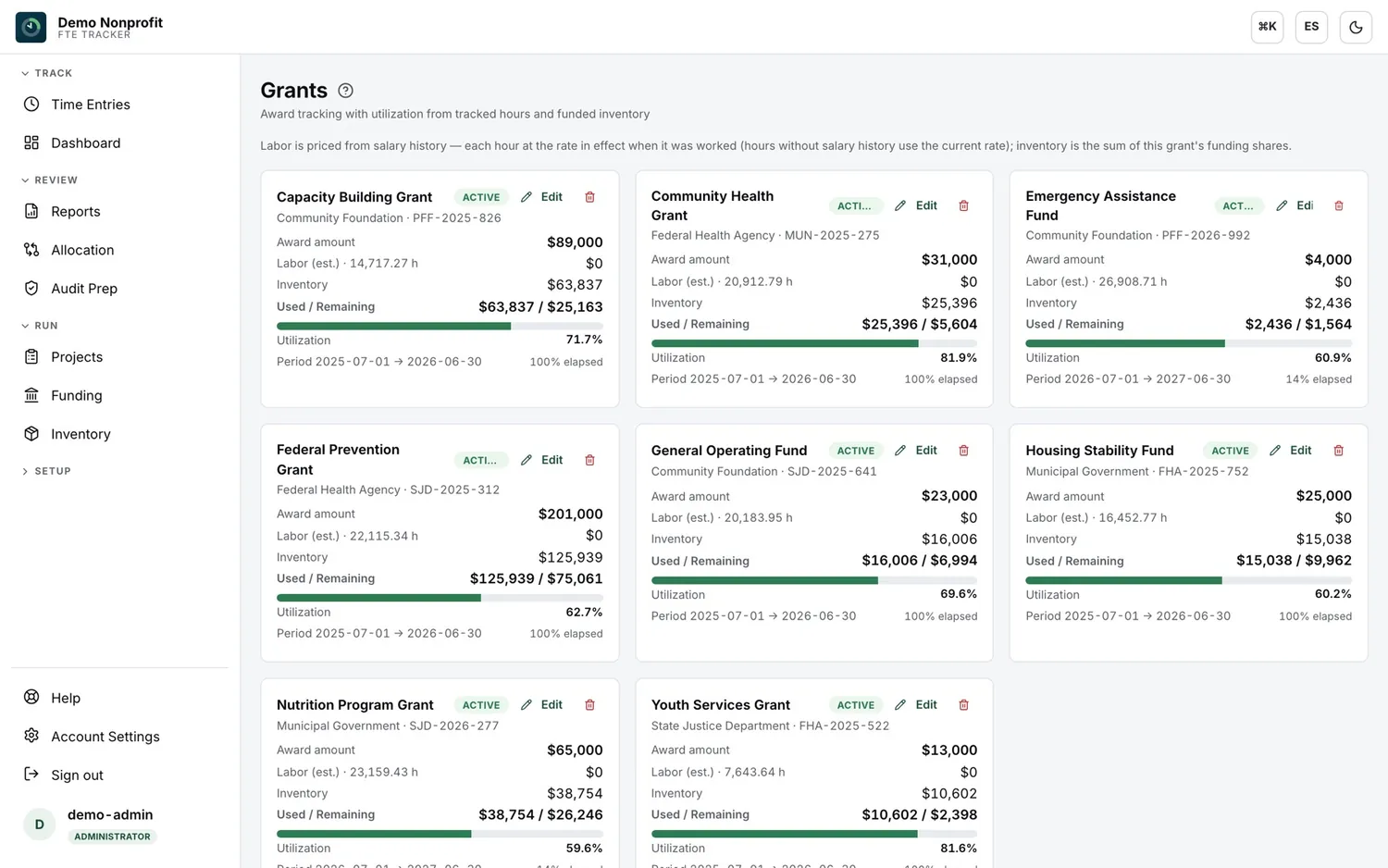
Straight talk
Two things we will tell you plainly.
Both of them are reasons to hire us for less than you came in expecting to buy.
01
If your bookkeeper is doing this well, we will say so.
We scope down to the parts that are not working rather than replacing a function that is not broken. Supervision and structure around a good internal bookkeeper is a real engagement, and it is a cheaper one.
02
If it is really a documentation problem, we will route you.
Handing us the monthly close does not by itself clear a time-and-effort finding. That work is an audit-readiness engagement, and it belongs on the compliance side of the practice.
Questions
What people ask before handing over the books.
What happens to our current bookkeeper?
Three arrangements work. Your bookkeeper stays on day-to-day entry while we own close, reconciliation and reporting. Your bookkeeper stays and we supervise and give the function structure. Or we take the whole thing. What we will not do is make a decision about a person on your team for you. That belongs to your executive director, and we say so on the first call.
How is this different from a regular bookkeeping firm?
Most bookkeeping firms do not work in fund accounting or federal award compliance day to day. We do. Time-and-effort documentation, subrecipient monitoring and SEFA preparation are built into the monthly close here, rather than bolted on as a separate project in the weeks before an audit.
Do you audit us?
No, and we cannot. If we prepare your books we are barred from auditing them, and that independence rule exists for good reason. We run the function and prepare the record; the opinion comes from an independent CPA firm that stays yours. We work alongside them.
Can you start mid-year?
Yes. Mid-year starts are ordinary. Onboarding simply accounts for reconciling whatever has already been booked, which is usually a few extra weeks in the transition rather than a different engagement.
Do we have to switch accounting software?
No. We work inside your existing system where it is fit for purpose, and we tell you plainly when it is not. If the system genuinely cannot distinguish funds and awards, replacing it is a separate decision on a separate timeline, and we do not bundle it into the decision to hire us.
Make the close boring.
Thirty minutes. Tell us how many funding streams you carry, how late the last close was, and who owns the payroll allocation today. We will tell you what it takes to make that unremarkable.
No charge, no deck. Bring your last management letter if you have one.
Or call the Puerto Rico office: +1 (787) 241-9147